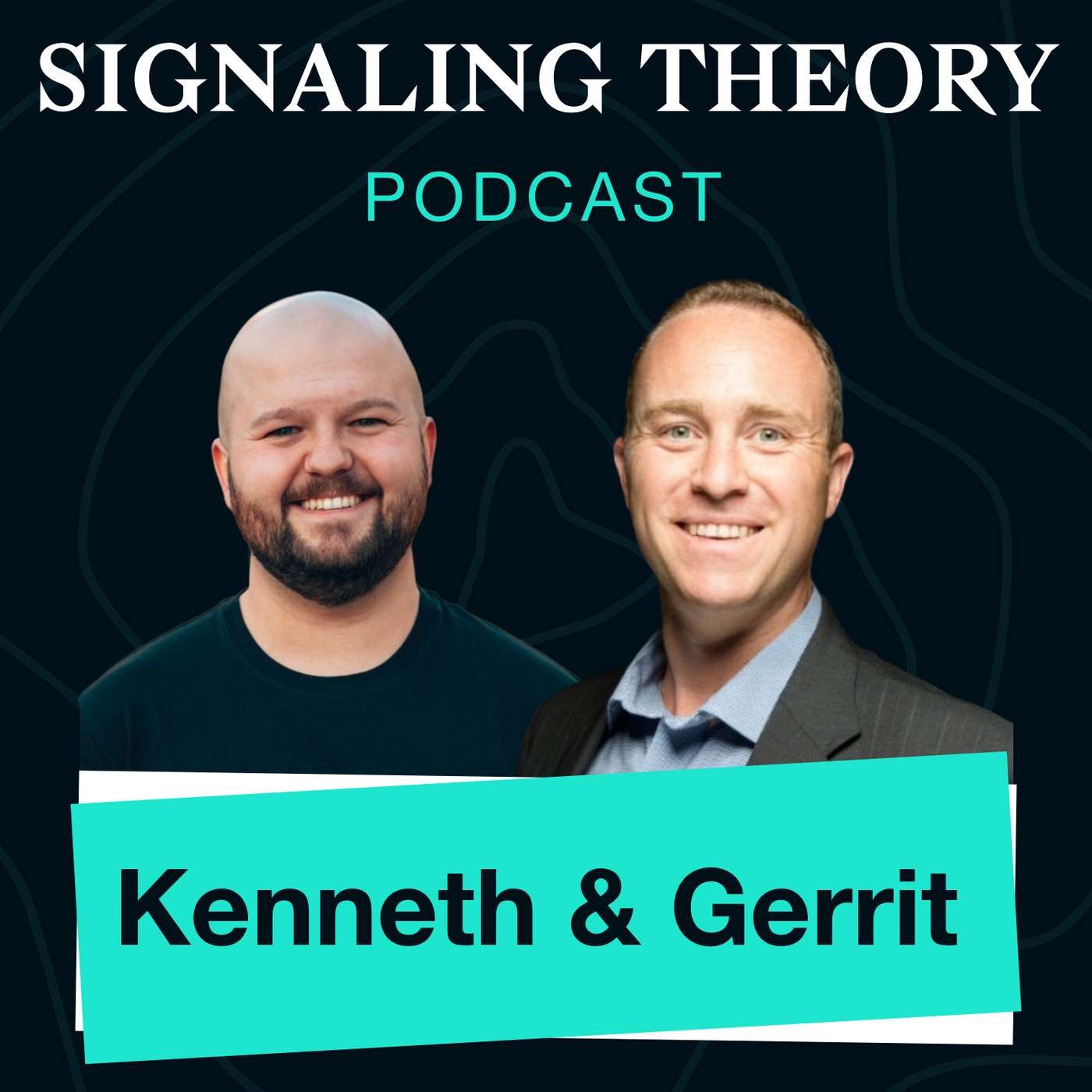
Episode 21
The Jobs Question w/ Kenneth Eversole, Dan Pollmann & Gerrit Hall
March 19, 2026 • 43:43
Host

Rex Kirshner
Guests



About This Episode
This week on Signaling Theory, Rex is joined by Dan, Gerrit Hall, and Kenneth Eversole for a thoughtful conversation about what AI is actually doing to the way people build, work, and think. They compare Codex and Claude in practice, talk through why better planning often matters more than raw speed, and wrestle with the growing gap between how powerful these tools feel to users and how negatively the public seems to view them. From tutoring and personalized medicine to job loss, dignity, and entrepreneurship, this one turns into a more philosophical discussion about what kind of future AI is really pushing us toward.
Transcript
Rex Kirshner (00:02.104)
Dan, Garrett, welcome back to Signaling Theory.
Dan (00:05.112)
Thanks for having us.
Gerrit Hall (00:05.579)
Thanks, pleasure to be here.
Rex Kirshner (09:51.712)
Kenneth, you just joined us. What's new with you?
Dan (10:05.272)
Thank
Kenneth Eversole (10:11.886)
I'm like deep in AI Twitter like way too much right now and like people who are building stuff probably helps that I'm building something and I follow them all, but it's pretty wild on how many people all of a sudden were like, oh, the slot code. And they're all now talking about this particular Carnegie Mellon study that came out where the rate of complexity is actually removing all velocity games from dev teams.
And it's really fascinating because like basically like all the all the games you get. You from like Greenfield brand new project like what that clot does codex. They are completely destroyed like after six months because it can't index the whole code base very well and then most importantly it likes to add a lot of logic very quickly and you're adding it so quickly that the comprehension of both developer is super low.
And then the actual numbers on the table of how fast you're going dropped. I think that came out three years ago. So that's been the thing I've been chewing on. What does this really mean? Do we need different tooling? Is this a different harness problem? I think it's a little bit of both. I think everyone who has
Dan (11:30.479)
you you
Kenneth Eversole (11:34.877)
worked around or worked at the industry long enough. It's like what's the difference between like a principal engineer and a junior is like a principal just stops and things like half like half as much more junior just like so frank out immediately. And I think that's the I would say the issue with the ability. The innate tooling around. Large complex operations are not there. And then the other one is.
Dan (11:49.358)
Okay.
Kenneth Eversole (12:03.646)
how selfish they all are. So there's there's like I I one of my cofounders started using codecs and I was like, oh, there's some cool tools over there. But it's not like oh, hopping into a new different IDE. I just install my extensions and I'm good and you know I can write Python code. You're kind of abandoning everything. Like all your memory or cloud.md files or agent like they don't move over there like that's in cloth land. I am now going to open AI land.
I leave all equipment at the door and don't do anything. That's got to change. I mean, that is kind of horrible, if you think about it in the long run. So there are two different things, but very new things. I don't have answers to them. I can ramble.
Gerrit Hall (12:54.315)
Well, I wouldn't swear to it, but I think if you type slash init in a codex, it will scrape kind of all the common files that get created by Claude, like Claude.md or agents.md, and does a pretty good job of kind of initializing that repository I found. I've been going down the rabbit hole of trying to trying to like boot benchmark codex against Claude this past week. So I've been diving a lot more into codex and it's been, it's been good.
Rex Kirshner (13:22.254)
Well, can you talk a little bit more about that? Cause I like everywhere I look on the internet, everyone's saying that Codex, whatever we're on four point or 5.4 is better than Opus four point, whatever. And so like every once in a while I'll pull out a Codex and I'm only on the $20 a month plan. So maybe you need the $200 a month plan to like get the good tools, but like, I'm just really underwhelmed by the like quality of things I'm getting out of it.
What's your experience?
Gerrit Hall (13:53.281)
So my experience has basically been that the UI or the user experience, guess, of Codex is just not as fun somehow, if that makes sense. Like Claude talks to you a lot more. It's a better writer. It's like kind of more fun to watch it think in the way that it talks. Codex, like by default, is very matter of fact and boring. But when I'm actually like just comparing the actual results, so like one of the tasks I did this past week was like a pretty major.
Overhaul and now that codecs is a plan feature which was largely the thing that had been missing until recently that I thought I'd stay on codecs by the way I'm only on the codecs $20 plan. I'm not in the like top-tier codecs plan either I had codecs write up a plan and then the exact same Text snippet I gave to Claude had Claude right of the plan then I asked each of them which plan was better but they both picked codecs like
Rex Kirshner (14:46.571)
Hahaha
Gerrit Hall (14:48.413)
And I agree, like I read through it and, like I found both like, you one was just sloppy and missed stuff. Like I'm trying this exercise more and more and like sometimes Claude wins. but like probably four out of five times codex seems to do better.
Dan (14:48.614)
that's it.
Dan (15:02.413)
I've been spending a lot. So I've been on a lot of flights lately and traveled a lot for the last month, like way too much. And so I haven't had a big machine near me. So I've been working on my phone a lot and just planning a lot or talking to it in plan. I haven't been building as much as planning. And I think that's transferred over now. I have the habit of spending a lot more time planning on my laptop when I'm in a
Airport terminal. And, and if you just spend the time to sit and plan and shoot holes in it you tell it, stop being so complimentary, stop saying this is going to change the world. Like we are working here. just stop fluffing and glazing so much. It's actually gotten a lot better. So if I plan for an hour a day and just talk about what the overall goal is, and this is in cloud, not codex, I stopped using codex because the plan.
wasn't there that feature on the same plan you guys are. But I wasn't getting anywhere over on Codex. So I just kind of default to Claude. And the more I plan and think about it, and to Kenneth's point, when I look at senior developers or guys that have been around forever, a lot of times it's not hands on keyboards just staring at the screen and not even, there's nothing on the screen. They're just thinking. that's sort of taken that.
Rex Kirshner (16:04.589)
Yeah.
Dan (16:30.75)
and started planning a lot more and things have gotten tighter. have a very tough problem to solve with a bunch of variables that change all the time. And spending probably 10 hours planning with Claude got me so much fun. And that's a massive amount of time. It has produced such better results than just jumping in and hear some slop.
Rex Kirshner (16:54.316)
Yeah, no, I mean, I think the one thing that is very clear through everyone's experience is the more time you spend on planning, better your results. think what can be hard is...
like finding the right angle and like the right moments to pause what you're doing and like think this is like a time to pause and think ahead. and I'm wondering if maybe they're like the correct, like, again, I saw all my problems with Claude now. Like I think maybe the correct thing to do is create, an agent that reverse prompts you and is like able to understand, okay, what you just delivered, the state of your code and then
kind of like feed you enough questions to like build out a plan from there. Cause like again, I just find that it's so easy to keep moving forward and never really feel like I need to plan cause it's like making progress, you know?
Dan (17:51.415)
Yeah. Yeah, I tried something the other day with that in mind and there's something called the far aim that as pilots we adhere to and the far aim is sort of the Bible, like do this, don't do this. And I just wanted to see if it knew anything about it. And I asked it to break the law and do something that it shouldn't do. And it knew right away. And there was no like time to go and think about it. was just like, no, that's illegal. You can't do that. I was like, holy cow.
That's amazing that it just had that right in memory. But who knows what it misses? So I was using it as a planning tool. was like, asking questions to do certain things. I was pretty shocked by that.
Rex Kirshner (18:35.094)
Yeah. Yeah. Cool. Garrett, what have you been messing around with or running into problems with?
Rex Kirshner (18:44.622)
Now you're muted again.
Gerrit Hall (18:48.333)
No major problems, but I did want to get your thoughts on this, which I found this, and I think I referenced it kind of without much context in the last session. Let me see if I can get this up. Can I have my screen share here?
Rex Kirshner (19:08.034)
I actually have no idea.
Gerrit Hall (19:09.729)
Let's see if this works. Okay. So this was a NBC news poll of various topics in their popularity ratings. And this was conducted maybe earlier this month. And artificial intelligence was a negative 20, which is like one of the lowest topics that they did, you know, as low as things like, you know, the Democratic Party and ICE and...
Dan (19:14.73)
you
Gerrit Hall (19:33.505)
various political politicians and I find this interesting because like I brought this up last week because Rex and I were talking about like crypto and aetherium which is also you know, it wasn't a topic here, but also incredibly unpopular and I just thought that um like this is amazing because I've like like for my sake like I'm at the intersection of two industries that are like you know if this French Revolution like they'd be pulling out the guillotine and I'd be kind of a major risk here
And I was trying to like think if this makes sense, because like everyone I know who is like not like on podcasts like this, like super plugged into AI, like I feel like they have kind of generic, like non terrible interactions with AI, right? Like their interaction is probably like they Google something and they get like a nice little blurb at the top that is more in depth than if they clicked on a website.
But then of course, there's also like the AI is stealing everyone's jobs narrative, which I could see being like extremely unpopular. so I don't know, like, was just wondering if you all had any thoughts on like AI, are you at the point where like, would you go home, for Thanksgiving in six months? Are you going to tell people that you work in crypto instead of AI? Because it's like, you're afraid it's getting unpopular.
Kenneth Eversole (20:48.175)
I mean, obviously it's like you people touting and be like, oh, it's gonna replace everyone's jobs is not gonna help anyone, especially people who are not technical. The other interesting observation along with that, all of my nieces and nephews that are under like 11 hate AI. And I don't know where they're getting this from. I don't know what teachers like still in the math class, like we hate AI, but it's interesting that they're all like, yeah, we hate AI. I'm like, whoa.
so I
Gerrit Hall (21:21.439)
aren't they using it for their homework? mean.
Kenneth Eversole (21:24.637)
I know. I don't think they are. So I do think there is something to be said about the perception of AI. I do think it's going to hinder it pretty badly overall. Because you need all these people involved to suss out good ideas. And if you have even like 20 % or 30 % of the population, it's not like, not just on the fence, but actively despise it.
Gerrit Hall (21:26.753)
Okay, good, good.
Kenneth Eversole (21:54.491)
You're going to it's a different conversation, I think overall. What are you saying, Rex?
Rex Kirshner (22:00.47)
No, nothing. Dan, do you see your kids have like a similar problem with AI or I'd love to like just unpack. Like it's crazy to me to think that people are against this, right? Cause like in our circumstance, it's amazing. And for like, look at my wife who's not technical at all and she uses it to like feed her, health anxiety or to like find answers on like plans to do or whatever. But like, I don't understand where the negative.
Dan (22:06.333)
No,
Rex Kirshner (22:30.008)
comes from. So Dan, like, what do your kids think?
Dan (22:31.496)
Yeah, my daughter who's 11 is not there yet. She's a good student. She doesn't really need it for anything yet. She doesn't really use it. We haven't really exposed her to it as much. My son, who's a bit more mature and 14, who's also a very good student, uses it for studying. So we kind of did an experiment where we
connected his G drive, his mathematics G drive with Claude and gave it access to that folder and asked to review it. I gave it the personality of an empathetic teacher that's caring and compassionate and looking to move along a student. And he had pretty good math grades. He's 90, 95 % and he's kind of a straight A student, but he has to work really hard at it. It doesn't come as easily as it comes to my daughter.
So he went in and we prompt, was having tough day, like tears and, you want to help your kids, but he also want to like, Hey, tough through this. And so, we reviewed his G drive and all of his homework, with Claude and looked for foundational. Problems what's missing in the very beginning that he might not be understanding. And was slope intersect or something. I can't remember what we're, we were working on, but he didn't have a foundational component and.
He, it was talking back to him and he was being pretty empathetic, like a nice teacher should. And man, did it lock into his problem and created a cheat sheet for him. Like let's work through this worksheet. And when you get done with this one, let's work through this one. So it found the root cause of the problem of what he didn't know. And then helped him. He doesn't anthropomorphize it like I do call it he or the, you know, he, he it's the machine to him, whatever. He doesn't care. It's Claude.
but now he's, whenever he has a problem, he's starting to skip me and mom and go to Claude and we only allow him Claude on a machine that we manage and watch. And I manage his time with it, but he's like skipping me now.
Rex Kirshner (24:43.39)
Well, maybe that's a bummer for parents, no, I, yeah, I mean, it's just, it's interesting to me how people are pushing back against it. And part of me wonders if it has like almost nothing to do with the technology at all and is more like people have really just turned on like the hot thing in the tech sector since really like the, there was a peak, right? Where like Facebook was really gonna
change the world and the Arab Spring and bring people together. And I think we're so distant from a world where we believe that these plunky college dropouts are here to disrupt the bad systems with new good systems. And maybe people just metabolize AI as the next wave that's even bigger than the last one, which is even bigger than the last one.
Dan (25:19.654)
you
Rex Kirshner (25:38.442)
There is something to be said for like the more consumer tech is in your life like this shit here your life can feel
Dan (25:45.136)
Yeah, one other point, which is kind of off topic for my kids, but you asked, know, how is it viewed? I'm down here with my in-laws spending a little bit of time before we go on spring break or in Florida. And he's my father-in-law's pretty technical guy and understands things. And he's about 75, 76. And I was asking him, you know, the same question, what are your views? What are you thinking about? And generally his mind goes to investing. That's what he wants to talk about.
And he didn't talk about how Anthropix doing or how Codex or whatever. He was like, what do you think the difference monetarily or how quickly, what's it going to cost to develop better LPUs or GPUs? That was his question to me. And I was like, man, that's, I wasn't expecting that answer or that, you know, he was answering my question with another question, but he's like, what do you think about this? I was like, holy shit, I haven't, like I haven't thought about language processing units.
That's not what I think about it. And, it was just a different, he was in a different head game completely. He it wasn't good or evil to him. was who's going to build the better mouse trap in, in two months. Yeah.
Rex Kirshner (26:54.934)
Yeah. Well, in the crypto world, we like to always say like, sell the picks and shovels, right? Like the gold rush came, like, don't be looking for gold, sell the picks and shovels. And so what I read in your father-in-law's question there is like, okay, like who are the actual companies that are winning right now? And like, who is going to essentially disrupt them?
Dan (27:06.48)
Yeah.
Dan (27:17.141)
Yeah, who's going to build the best transistor to do whatever we're asking it, which is kind of another interesting topic.
Rex Kirshner (27:24.077)
Yeah.
Gerrit Hall (27:27.251)
One random topic. go ahead. I was going to change subjects. So why don't you start.
Kenneth Eversole (27:27.409)
Yeah, I don't
Rex Kirshner (27:29.195)
Kenneth Eversole (27:33.789)
I mean, I think that's where people don't like it. That was my immediate thought when you said, who's going to disrupt them? I don't know if any of you have read anything about chip manufacturing. like, is crazy capital intensive. You need $10 billion and it can still fail. And I think that's where there is this, like, to take the Batman quote or whatever. It's like,
Do you be the hero? you stay long enough to be the villain? I do think that's where Silicon Valley found itself. Because like, I don't know how you could ever disrupt Nvidia. I mean, AMD did it, but they're also a massive gunglomer, big giant company. Like, I don't see a kid in their college dorm room being like, I did it! I now have the next LPU. Like, that feels, yeah.
Dan (28:09.99)
Okay.
Rex Kirshner (28:22.902)
Yeah, you know, in some ways, similar to saying like, who's going to disrupt the aircraft carrier. It's like, that's not really like how things work.
Kenneth Eversole (28:34.288)
drones.
Rex Kirshner (28:36.408)
Yeah, yeah, okay, fair enough.
Dan (28:40.479)
Yeah, that book, I putting in a plug for that book, Rex, that you told me to read Chip Wars, where they talked about Silicon Valley and inventing the transistor and why it actually went to Taiwan. That is a fascinating book. If you guys have read that book, I can't do remember who it's by, Rex. You turned me on to it. Yeah, I mean, it was just fantastic. Like, here's why we failed at it. We could never get to this level, but holy shit, Taiwan could. So.
Rex Kirshner (28:55.818)
No, don't. Yeah, chip wars. It's a one.
Rex Kirshner (29:05.986)
Yeah, yeah. All right, Garrett, take us to the next topic.
Gerrit Hall (29:11.563)
Well, it seemed like there was a slowdown. So I was going to just pause it like a conversation that I was having with someone recently that I thought maybe you all could weigh in on. Cause obviously like the narrative around AI is like, you know, it's going to take all these jobs, blah, blah, blah. and you know, when you think of like cases where it might not be true, it's like, all is very limited, right? Like if the four of us started a company, maybe like we'd hire 15 people or 50 people if it went really well, but we're
probably not going to be creating massive amount like, know, to like.
Make AI popular on the scale of influencing an NBC level survey, where it's surveying the country. You're talking about not creating a few specialized niche jobs. You're talking about AI would have to the capacity to create jobs that kind of pass this test I'm inventing in my head of a strip ball test. I'm thinking 20 years ago when cell phones came along, every strip ball had a T-Mobile store, an AT &T store, a singular back then store, Verizon store, whatever all the brands.
Rex Kirshner (30:07.566)
You
Gerrit Hall (30:12.131)
were, um, we're like, you know, it wasn't a fantastic job, but it was everywhere. And like anyone in the country, like who was like moderately skilled, um, you know, like, and able to hold a job could like get employment there for a little bit. And those have gone away and they've largely been replaced by things like vape shops or like weed stores or things like that, which are probably not, I mean, you could say that social, that, that cell phones are making the country like bad in some cases, but probably vape shops like have much more real harm.
Um, but like, do we think AI could actually create like a whole class of jobs that like could be like distributed out to strip mall type, uh, jobs across the entire country, uh, and actually like spark this like type of Renaissance of like, you know, someone who's just graduated college, looking for an entry level job might actually have jobs available because of AI. And I have some like ideas that I brainstormed and going through this, but I'd be kind of curious to put you all on the spot and see if you think that like there is like,
mass kind of like less skilled jobs that could be created and distributed across the country in such a way.
Dan (31:22.83)
That's an interesting question and sort of dystopian in some ways. I just went to a negative place. Go ahead, Rex.
Rex Kirshner (31:27.342)
Well here
No, no. Yeah. I'll answer first, but you guys think of something. You know, Garrett, you actually, like had me thinking about this a few weeks ago. when we were in Denver together and, you know, you made this comment about how like you go outside, you walk around and you see, especially in Denver or Los Angeles where I am, right? Like there's homeless people everywhere. And at the same time, you also see that like, there's so much work that could be done to make things better.
Right. Like cleaning graffiti, like cleaning up trash, just like effort that, like, that needs to be done in order to make the community a better place. And like that to me and to Garrett, when I think to you, cause you said it right. It's like, wow, here's a problem and here's people that like need something to do. And like, there has to be a way to solve for that. Right. And so.
I think there's an answer there. think there's an answer in a couple of weeks ago, there was like the major snow storm in New York and the new like socialist communist mayor, like offered people $40 an hour to shovel snow and they like didn't have a snow problem. And it's like, okay, like people are willing to work for like livable wages and,
And I think like the big thing is these jobs have to be like dignified and people need to be proud to do them. And a couple of episodes ago, I was talking to my friend, Matt, and he was saying like, okay, the big problem we have right now in delivery, right? It's really the last like hundred feet, right? Like we can get an autonomous car to your street. It's just like, how does it get to your house? And he envisioned this world of like, what if there's a guy like in busy cities, right? That like,
Rex Kirshner (33:20.418)
had just like a four block or two block or one block radius. And all they did was like run out to cars, bring the thing from the car to the store and bring it back. like, you know, maybe that would promote just like more community development, seeing the same faces every day all the time. Like people would know the stores so there wouldn't be like the inefficiency of just like random drivers trying to figure it out. And like, I can see a world where this works out and really helps us.
empower like solid middle-class jobs that have dignity and that like allow people to live. But, you know, I think maybe one of the reasons people really hate AI is because you look at the people who are in charge of this and are deploying it and it's not really the people that are pushing for society in that direction, right? It's like private jet, private island, like promote like genocide through their.
social media algorithm people. I don't know, I guess I'll let Kenneth or Dan take it from here, but I think there's a path forward. just like, I'm kind of concerned about our ability to make it happen.
Dan (34:32.354)
Yeah, jump in there, Kenneth.
Kenneth Eversole (34:35.56)
Yeah, um, I could be a little positive. I think there's so much unknown, unknown potential with like unlocking and giving people. I mean, I have met so many people in my life and I've grown up in like the, I was talking to someone earlier today, there's like this generation right now, like upper millennial to like zillennial and like upper Gen Z that
When they see a computer, they know how to like will it to do something like I mean, we all like learned a little bit or either like the early internet writing websites to like where we are now you have to like you can now command a cloud to like go make your website. But you kind of understand what you're looking at. But if you could talk to like an 80 year old, they're like, what is this computer? Like what if the what if the power goes out like well, the power is not going to go out tomorrow and these are highly important to society. And then when you look at the the other end of it.
where I see like little kids, they like everything's a screen. Like everything's a screen, you touch it, they assume it works. And where I'm going with that is I think there's so many people, even in the category of like, they kind of know, of like unknown, unknown potential of creation, that we're just not ready for it. Like, I mean, there's a lot of scientists and doctors, and I mean, everyone goes at the medical field, but like, there's a lot there. I would say that they will create jobs that like robots aren't ready for.
You need to be delicate. You need to be this, like whatever, that are very dignified jobs that are like highly inefficient right now because they have tons of process. And then the other one, it was a thought experiment as you guys were talking. I was like, what happens if like all secretarial work or whatever and accounting and like document processing is fully done by AI? Because I mean, I think we can all agree that that is easily in the doc.
That's gone. Like that needs to be gone. There's like the that's definitely technically can be achievable, but also like if anyone's ever dealt to be pick on Saint Louis, like if anyone's ever dealt with the Saint Louis City Hall for business stuff is like the worst, most inefficient thing on the planet. And there's like 1000 other examples. I don't think that's unique to Saint Louis. I think that's unique to America right now, where government has enormous amounts of.
Kenneth Eversole (36:58.543)
Inefficiency just for bureaucracy and like I think enterprises have it as well that if in the world they like say we made governments 100 times more efficient, but they still taxed at the same level. They could probably do public work level projects like we saw in like the 40s and 20s and 30s. Like they could just like get that road that roads now fix today that bridge. We're going to redo that tomorrow and those are.
very dignified jobs that I mean, I'll never be, you know, I've never read anything in my life. They're like, you know what, building Hoover Dam, terrible, terrible experience. I do not enjoy anything about that. And I think that's really where we're gonna see a lot of like proud jobs. I mean, the people that are sitting at the DMV processing licenses,
They are mean and I don't think they like their jobs. And I think they're mean because they don't like their job. But I think that the image of the people building roads and rate trade, like building big things, bigger than themselves, I think there's something to be said there.
Yeah, I mean, that's kind of my different take on it. think there's like a lot we're trying to pigeonhole the future into what we know.
and be done now. Yeah.
Gerrit Hall (38:21.429)
Can I go ahead then?
Dan (38:24.729)
So when you first asked the question, Rex, it, went back to the show called Lost. That was, I don't know if you guys watched that show, Desmond entering the code. Yeah. Entering, entering the code, you know, every 24 hours. So you're a slave to AI. So I sort of went to this like dystopian worldview.
Rex Kirshner (38:30.958)
We're not that young.
Dan (38:44.224)
And then actually I started thinking about this other thing I've been thinking about. So if you're familiar with the K-shape theory of wealth, so like the bifurcation of economics, so the rich get richer and the poor get poorer. And I started thinking about if it's so easy to use these tools now, and maybe there's someone that hates their job at the DMV, which I think you're 100 % right. Everybody hates their job at the DMV.
But if there's these tools now where someone is vibe coding or stop coding or throwing something together because they have a free or a $20 membership to Codex or Anthropic, you know, and it's this thing that this person wouldn't be able to do otherwise because they have to work so much just to make ends meet, just to eat shitty ramen. But because of these tools, they can do something. Then that...
actually puts a smile on my face because I'm like, okay, well, there's some good in the world around that. They're able to create whatever tool they needed that helped other people or did something good in the world. It's a little ultra ultraistic, but it, you know, it's a kind of a glow around the world as it were. But I think there's some good that might be out of, might come out of it in the future. I hope there is. I hope the tools that I'm building will someday do some good. So.
It's quite a rosy way to look at things given the climate right now, not only the climate, like the climate that we're seeing, all the change. By the way, there's a 350,000 acre fire in Nebraska, which hasn't happened before last week. Like what? But also the political climate. I don't know. Rose colored glasses are sometimes okay. Last week I needed them.
Gerrit Hall (40:32.843)
Well, why don't I go ahead and answer the question I posited with some more optimism. Which of course, like this is just like, you know, at the moment, half-baked idea, but I'm sure you also all saw this news story, which I think was badly misreported by all reports. But basically like the story being that like someone was able to like for $3,000 sequenced their dog's genome and create an mRNA therapeutic or vaccine or something for it.
Rex Kirshner (40:50.296)
Yeah.
Gerrit Hall (41:02.561)
got it approved and then was able to reduce this dog's tumor by 75%. And I don't exactly know the details of the story, even having read it, how much of it is actually true or not. But it did get me thinking that that hypothetically could open up some whole new class of highly personalized medical treatments for people who are in an extreme terminal state. And if you actually have something like this, you would need...
strip ball type offices across the country where people could go in and find like a local person to like sequence whatever. I'm not saying like cancer necessarily or something. Presumably if it's like for terminal patients then like right to try like even kind of cutting edge frontier medication. You know like that's a place where I dangerously skip permissions and be willing to like take some random pill that someone created and like.
Rex Kirshner (41:54.126)
you
Gerrit Hall (41:57.973)
maybe it could actually do a wave of good and also contribute to science. So I could actually see a future where the, because one of the big critiques of this whole thing was that there's a big difference between creating something in this case for a one-off gene sequence for a dog and actually getting a cancer treatment that passes a randomized control trial and could be done at the population level. But maybe like,
this could actually open up like individual level treatments for people. And I could see that applying to like a variety of things that aren't cancer, right? Like nutritionists, for example, that's an example where if you like ask like, what's the right thing to eat, the answer is always, it depends on like your particular body. You know, like maybe one of you can't digest lactose and all of a sudden like everything goes out the window in terms of like, you know, how much Greek yogurt should you be eating? But like you could get to that level of like,
data for an individual person. And it'll be the kind of thing where like, would have to have most likely people like understanding, understanding these results and like able to work with you and consult with you on like very tailored, like individual health plans that could only really be done, like with this kind of like human, and machine hybrid connection. So I think if there's like cases like that, that I can imagine there's probably dozens of other things where you could actually like,
do mass good for humanity and also like have a mass explosion of new AI powered jobs. That's just like some random example.
Dan (43:28.647)
Yeah, and it kind of supports, you know, normally we would have gotten a tutor. We would have paid someone to come to our house and teach our kid what he didn't know about slope, slope intersect or whatever he was having problem with. And the fact that Claude was there to do it in a very helpful and compassionate way. There's good there, right? Again, Rose colored glasses on that.
Rex Kirshner (43:55.436)
Yeah, look, I think I think that if you take the capitalist lens off for second, it's so easy to be so incredibly bullish on the way life is going to get better because of AI. The designer drug thing has always been a cool what if, but this story with the dog, it's like, shit, we're here. Someone needs to operationalize that, but we're here.
You know, and that's not just an AI story. That's an mRNA story. Like Dan, the tutor example is amazing. Like the, the journey that I'm going through right now is, you know, I've talked about it on a few, um, earlier podcasts, but like, I am just throwing all of my personal data into Claude and saying, like, I want you to turn this data, whether it's like a text message conversation or an email or whatever.
turn it into a JSON object that has all of this like really rich metadata that LLMs can use to like synthesize. And like my whole thought is like Facebook, TikTok, all of these Google, all of these companies have these like incredibly rich, nuanced psychological profiles of us. And like for the first time, Claude is allowing me to have sovereignty over that and like do something with it in a way that Facebook
like doesn't allow me to do, right? So I can come up with all these good things. I think you put the capitalist helmet back on and like the scary thing about all of these things is like at the end of the day, what we're talking about is making things so efficient that we get these incredible new results. And like what that means is we're cutting people out, right? Like, Dan, like I'm really happy for you that your kid is getting nuanced personalized, like tutoring there, right? Like that's a objective good.
But like, that's also a job that someone doesn't have. Or like the story with a dog, right? Like that probably would have taken like 30 researchers, like good well-paying jobs in order to get that result. And then you can kind of like cut that down to a couple thousand dollars. It's just like, those are jobs. And I think what we're about, we're going to run head first into is exactly what happened with the first.com boom, which is.
Dan (46:08.509)
Interesting. Yeah, I said something to my client that you never say in my world.
Rex Kirshner (46:14.636)
Yeah, all manufacturing's going away, but we can just train everyone to be a computer programmer and everything will be fine. And then you go look at the Rust Belt and that's just not what happened. They didn't learn how to be computer programmers, they learned how to be opiate addicts.
Kenneth Eversole (46:30.704)
Hmm.
Dan (46:35.932)
So I was at a meeting last week and there's five of them there. And these are guys that do the job that my thing does. And they're, they're operators of big sensors and cameras. And they sit in the back of these aircraft and do it day in and day out for four months in the spring and four months in the fall. And I said, listen, I am not here to take anybody's job, even though this is completely autonomous now and does it by itself and it works and it works.
really, really good, like a 99.2 % success rate. My job, like, I can't live with the fact that I would take away your job because right now you're feeding your family with that. There's five of them there. And it's for a very, very, very large $40 billion company. And I said, if that's going to happen, like, I don't know how comfortable I am like using this or getting, getting in bed with you guys. And
They said, no, it doesn't. No job, job loss will become a, become of this. we implement it, we will look at more things and investigate things we normally would have put off for a year. So I'm comfortable with that. Right? Like I'm comfortable with the use of it in a, in a way that doesn't pull jobs or this person can no longer like, what are they going to do for a job now? Cause what I did automated their tasks. So that's a.
It's a heavy thing to think about at night too, like shit, did I just build something that will take away 1500 jobs in the first year it's deployed? That sucks.
Rex Kirshner (48:09.518)
You
Kenneth, I saw you playing with the mute button.
Kenneth Eversole (48:16.451)
Yeah, I don't know. mean...
I think like the physical space is so hard. Like actually deploying robots not just in like a factory floor. think it's like we made it a lot easier. And to make this like. This I don't know the dot com like boom didn't have people actively building like. Rockets and getting ready to go to like Mars and like things like that. And I think like if I were to like really.
I mean, I don't know. Maybe it's like the full blown buying the capitalistic mindset of it. I really think it's like we're giving up all these jobs because we have some bigger ones to make on. Like way bigger ones. we actually do go to Mars or whatever and it's like an actual viable career path in like a hundred years or whatever. We have to give up a lot of the clerical work down here. have to like...
Dan (48:55.163)
Okay. Okay.
Rex Kirshner (48:58.798)
Mm.
Kenneth Eversole (49:15.601)
Because like, I don't know, like there's also not enough people, you know, like we all like, it's kind of interesting all of a sudden, like, like three years ago, was like, the population, the population, then all of a sudden, like AI comes out, like, what about all these people's jobs? like, like, I mean, I there's also an interesting case to be made, like we have to be more efficient as a society. I mean, like, if you look at those numbers, like, there's gonna be like two old folks for every, like 40 year old or whatever, it's like,
Rex Kirshner (49:30.434)
Which is...
Rex Kirshner (49:42.915)
Yeah.
Kenneth Eversole (49:45.073)
We have to be twice as efficient. I mean, the issue there, I mean, always comes back to it as like, are the right people getting their fair share of the pot? Or is it like, are we just going to sit around and look at five quadrillionaires and be like, yeah, that's cool. That's cool. Where's my part? I think, I mean, that's always kind of weirdly been the human capitalistic problem, but that's a different thing than AI. So.
Dan (49:59.482)
Okay.
Rex Kirshner (50:00.824)
you
Rex Kirshner (50:09.58)
Yeah. No, man, I hear you. like the thing I always think about is, like, Dan knows us better than the rest of us with like grown kids, right? But like childcare is notoriously like the most expensive thing, right? But then you look at the people actually doing the childcare and like they're not making living wages. And so there's like some
real disconnect with like, why is this the most expensive thing in basically every parent's budget? And the people that are doing it are getting paid like not dignified wages. And so, you know, I think like that is what needs to change. And
And like the story of AI is not that story, but like, unfortunately, while we're still in that dynamic, the story of AI is going to look like the story of accelerating that dynamic.
Dan (51:13.658)
Yeah. It's a good way to leave it. kind of went up and down. We had Rose. I thought I put Rose glasses on for a second, and I was like, oh, shit.
Rex Kirshner (51:16.022)
Yeah. Yeah. All right.
Rex Kirshner (51:24.128)
Yeah, no, I don't know. I don't know if there's anything to do other than just like accept that this is the world that we're in and just try to like continue to be amazed by like the things that we can do in the meantime.
Kenneth Eversole (51:37.885)
I do you really think that, I mean, like, I don't know, I like, I see it, like I see it, but then there's also like a part of me being like, does this not give, I'll use a completely different field, like take like a massive exact person here in town, like Hoffman Brothers or whatever, like, I'm not gonna shout out, but it's like.
There are a lot of electricians that would love to bid on some of the jobs that they do and they don't have the staff. They don't have the sales team. They don't have anyone. It's like I wonder if there's actually a different path on this entirely or like all the massive enterprise like I'm talking like the fortune 100 like really all they're doing is like giant. This individual workflows based on like teams and teams of people. But in reality, like if.
I just think there's a world where those people like there's more competition there, like significantly more. It gives a lot more people the ability to fight a battle that they were typically like, well, I can't do that. I don't have 50 people on my team. I don't have a thousand people. I'm not centenium level. I don't have 150,000 employees. can't obviously go compete for medic. It's like, I don't know. Like it just feels like it's more obtainable to some degree.
Rex Kirshner (52:58.221)
I guess.
Rex Kirshner (53:01.902)
Yeah, for sure, man, for sure. think, again, there's a world where we're paying people $40 an hour, $50 an hour to keep the community safe and vibrant. if we pay people good wages and make them feel like what they're doing is good for the community, people would love to pick up trash, right?
Kenneth Eversole (53:24.253)
But that's I guess that's my challenge is like in I have a good buddy He's a machinist and like in a different world if I all of a sudden come up with money I'm gonna go start a machine shop and do that But he always he's he's from Italy and he's from modern Italy, which is like I think we're like Lamborghini and stuff like that is he talks all the time how in America like if you want to get a ball, you got to go call like McMaster car and
Like, you're not going to get their phone. Like, no one's going to pick up the phone to some guy out of his garage. But in Italy and like a lot of places in the world, you just go down to the shop on the corner, you know, shop in town and say, hey, can you make this very particular bowl for me? need 500 of them. And there's actually like a localized dynamic that's significantly more, I mean, we call that entrepreneurial. just, don't know what to call that without putting that capitalistic mindset on it. I think, I think that's what it would be more of. People will be a little bit more.
self-reliant or more like entrepreneurial at that level versus like, here's 50 bucks, go clean up my trash versus like, I can now go run a small, don't know, everyone needs the trade example, so I'll use it, but it's like, how much money does a person really need? And I think a lot of people will go, I'm pretty chill. Like I don't need like a billion. I don't think most people want a billion. I think they like the idea, but I,
Dan (54:36.953)
Thank you.
Kenneth Eversole (54:52.029)
I don't know, I've just met a lot of people, especially in the software space, who are like, I'm not a tech guy, I can't code. It's like, well, now you can code, like, go have it. And that to me is like, I'm not an accountant, but I can have a blog help you do accounting, and it does a pretty damn good job. I think that's, that to me is the rose-colored glasses back on. I want to see a world, I do want to see this world, like, heavily where like,
Dan (54:59.313)
Yes.
Kenneth Eversole (55:17.339)
McMaster cars not the only person or two people in the game that I can buy bolts from because they bought everyone because everyone doesn't have you know, all the middleman stuff or you know personalized medicine is really a thing because I don't have to go to the one giant hospital in town. So we can run a practice pretty effectively like or yeah, I don't know. I think that's where.
I think it is more entrepreneurial, like in the end.
Rex Kirshner (55:44.62)
Yeah. No, I, Go ahead.
Gerrit Hall (55:45.919)
I guess, for my S yeah, for my sake, I've like, I feel like there's been tons of technological revolutions and there's always been kind of like these like hyperbolic concerns about what's going to bring. And at the end of the day, like, obviously things do change a lot, but, you know, capitalism kind of always finds a way there always tends to be like need for things. People tend to like get hired to help in relief of that. Like capitalism is always selling cures for suffering.
And as far back as Buddhism, like one of the fundamental principles of Buddhism is that suffering is eternal. So like, no matter how much things change, people are always going to find things to gripe about and capitalism is always going to be there to like peddle some cure for it. Which makes me optimistic that there's always going to be money changing hands and people getting hired. So I think that the, like we're definitely going to go through some unprecedented changes. And I think that
still at the end of the day, like the basic human things are still going to be there in 10 years. Like, like you were saying, Rex, like we're still going to be having families. Like we're still going to be like trying to take care of the families the best way. Like you were saying, Dan, we're still gonna be trying to educate kids. like these are like timeless things that are going to continue to be like struggles for all of us.
Rex Kirshner (57:01.422)
Yeah, I think that's a nice place to end it. So fellas, this one was definitely a little bit of a sad one and definitely a philosophical one, but appreciate the time and I'll see you next week.
Dan (57:15.071)
See you.
Rex Kirshner (57:16.46)
All right, no.